
The Science of Supplement Stacking: How to Optimize Your Routine for Real Results
I see it every day in my practice. A person walks in with a cabinet full of high-quality vitamins, yet their blood work shows they are still deficient in key nutrients.
It is a frustrating cycle. You spend your hard-earned money on the best formulas, but you feel no different. The truth is that health is not just about what you swallow. It is about what your body actually absorbs and uses.
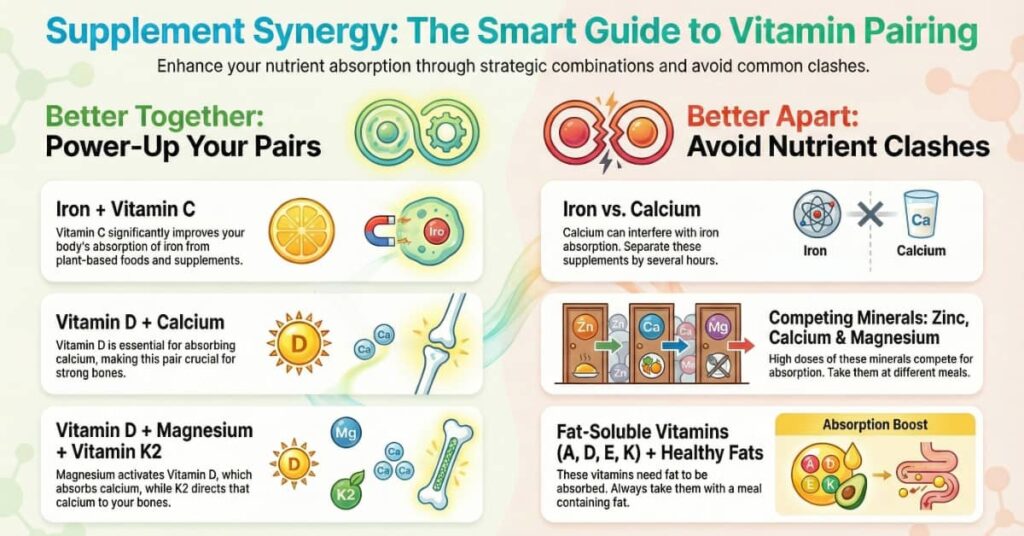
To optimize your health, you must understand that supplement timing and nutrient pairing are critical for maximal bioavailability. To avoid nutrient antagonism, you should separate competing minerals like calcium and iron while combining synergistic pairs like Vitamin D3 and K2 with healthy fats.
Think of your body like a complex biological machine. Some nutrients are best friends that open doors for each other. Others are rivals who fight for the same seat on a crowded bus.
If you take everything at once in the morning with a cup of coffee, you might be wasting more than 50 percent of your investment. Let us walk through how to fix that.
The Power of Synergistic Pairings
Synergy happens when two nutrients work better together than they do alone. In the world of clinical research, these pairings are the gold standard for moving the needle on your health markers.
1. Vitamin D3 and Vitamin K2
This is the ultimate partnership for bone and heart health. While Vitamin D3 helps your gut absorb calcium, it does not always know where to put it.
Vitamin K2 acts like a traffic controller. It activates proteins like Osteocalcin and Matrix GLA, which direct calcium into your bones and teeth. Most importantly, it keeps that calcium out of your soft tissues and arteries, where it could cause hardening.
2. Magnesium and Vitamin D3
Many people do not realize that Vitamin D3 is biologically inactive when you first take it. It must go through two conversion steps in your liver and kidneys.
Magnesium is the required cofactor for the enzymes that perform this conversion. If you are low on magnesium, your Vitamin D will stay “parked” in its inactive form. You might see your levels stay low despite high-dose supplementation.
3. Iron and Vitamin C
Iron can be quite difficult for the digestive tract to handle. Non-heme iron, which comes from plants and most supplements, is particularly stubborn.
Vitamin C creates an acidic environment in your stomach. This keeps iron in its “ferrous” state, which is much easier for your body to pull into the bloodstream. It can significantly reduce the constipation often associated with iron pills.
4. Curcumin and Piperine
Curcumin, the active compound in turmeric, is a powerful anti-inflammatory. However, your liver is very good at identifying it as a foreign substance and flushing it out quickly.
Piperine, the pungent alkaloid in black pepper, inhibits the metabolic pathway that eliminates curcumin. This simple addition can increase the bioavailability of curcumin by up to 2,000 percent.
5. CoQ10 and Selenium
This combination gained fame after the KiSel-10 study. Researchers found that older adults taking these together had significantly lower rates of cardiovascular death.
These two nutrients work together to reduce oxidative stress in the heart muscle. They provide the cellular energy needed for your heart to pump efficiently as you age.
6. Zinc and Quercetin
In the world of immune support, this is a “lock and key” relationship. Zinc is excellent at stopping viral replication, but it is a charged ion that has trouble crossing cell membranes.
Quercetin is a plant flavonoid that acts as an ionophore. It essentially acts as a shuttle, catching the zinc and carrying it through the cell wall so it can do its job.
7. Magnesium and Vitamin B6
If you struggle with high stress or PMS, this is a pairing to watch. Vitamin B6 helps transport magnesium across cell membranes into the areas that need it most.
Clinical trials have shown that for people under severe stress, this combination is significantly more effective than taking magnesium by itself.
8. Vitamin C and Glutathione
Glutathione is often called the master antioxidant. However, it is very fragile. When it neutralizes a free radical, it becomes “spent.”
Vitamin C can donate an electron to “recharge” the glutathione. This creates a continuous loop of protection that keeps your cells safe from environmental damage.
9. Vitamin A and Zinc
Your liver is the primary storage site for Vitamin A. To get that vitamin out of storage and into your eyes or skin, your body needs Retinol-Binding Protein.
Zinc is essential for the synthesis of this protein. Without enough zinc, you could have plenty of Vitamin A in storage but still suffer from symptoms of deficiency in your tissues.
10. Omega-3 and Vitamin E
Fish oil is highly unstable. Because it is a polyunsaturated fat, it can turn rancid (oxidize) easily when exposed to heat, light, or oxygen.
Vitamin E is a fat-soluble antioxidant. It sits inside the fish oil molecule and prevents it from oxidizing. This ensures the oil stays fresh and beneficial until it reaches your cells.
The Red Flags: Combinations to Avoid
Just as some nutrients help each other, others can block each other. Taking these together can lead to malabsorption or, in some cases, dangerous side effects.
1. Calcium and Iron
These two minerals are rivals. They both use the same transporter, known as DMT-1, to move from your gut into your blood.
If you take them at the same time, the calcium will almost always win the competition. This can reduce your iron absorption by half. Always space these out by at least four hours.
2. Zinc and Copper
This is a delicate balance. High doses of zinc trigger the production of a protein called metallothionein.
This protein has a very high affinity for copper. It traps the copper in your intestinal lining and prevents it from entering your system. If you take high-dose zinc for a long time, you can actually create a copper deficiency.
3. Vitamin E and Vitamin K
In high doses, Vitamin E can interfere with the way Vitamin K helps your blood clot.
If you are taking more than 400 IU of Vitamin E, it can antagonize Vitamin K’s action. This increases the risk of bruising or internal bleeding, especially if you are already on blood-thinning medication.
4. Green Tea and Iron
I love a good cup of green tea, but timing is everything. The polyphenols and tannins in tea bind strongly to non-heme iron.
They form an insoluble complex that your body cannot break down. If you drink tea with your iron-rich meal, you may lose most of the iron content of that food.
5. Calcium and Magnesium
In nature, these often appear together. However, in high supplemental doses, they can be antagonistic.
They compete for the same absorption pathways in the small intestine. Many experts recommend taking your magnesium in the evening to help with sleep and your calcium in the morning or afternoon.
6. St. John’s Wort and 5-HTP
This is a safety warning you should take seriously. Both of these natural remedies increase serotonin levels in the brain.
Taking them together can lead to “Serotonin Syndrome.” This is a dangerous condition that causes confusion, rapid heart rate, and high blood pressure. Never mix serotonin-boosting supplements without medical supervision.
7. Vitamin C and Vitamin B12
There is some evidence that high doses of Vitamin C, specifically over 1,000 milligrams, can break down Vitamin B12 in the digestive tract.
If you are taking both, it is a good idea to take them at different times of the day. A simple two-hour window is usually enough to protect the B12.
8. Melatonin and Valerian
While both are used for sleep, “more” is not always “better.” Both impact the central nervous system to induce relaxation.
Combining them can lead to excessive sedation. You might feel extremely groggy the next day, or your breathing might become too shallow during sleep. It is better to choose one that works for you.
9. Fish Oil and Ginkgo Biloba
Both of these are popular for brain health, but they both have mild antiplatelet effects. This means they make your blood less “sticky.”
If you combine them, you could significantly increase your risk of bleeding. This is especially concerning if you have an upcoming surgery or are taking aspirin.
10. High-Dose Zinc and Iron
Just like the calcium interaction, zinc and iron are competitive. On an empty stomach, they fight for the same entry points.
If you are trying to correct an iron deficiency, avoid taking your zinc supplement at the same time. The iron uptake will be significantly lower, slowing your progress.
Designing Your Perfect Daily Schedule
Now that we have covered the science, let us put it into a practical routine. You do not have to be perfect, but being consistent will change your health.
The Morning Kickstart
Start your day with your Iron and Vitamin C. Take them on an empty stomach with a glass of water.
Wait at least one hour before having coffee or tea. This ensures the tannins in your morning beverage do not block the iron you just took.
The Mid-Day Power Meal
Lunch is the best time for your Fat-Soluble Stack. This includes Vitamin D3, K2, Vitamin A, Omega-3s, and CoQ10.
Always eat a meal that contains some healthy fat. A few slices of avocado, a drizzle of olive oil, or some salmon will help these nutrients move into your system. This is also a great time for your Curcumin and Piperine.
The Afternoon Buffer
If you are taking Calcium, the afternoon is an ideal time. It is far enough away from your morning iron and your evening magnesium to avoid competition.
The Evening Wind Down
As your body prepares for rest, take your Magnesium and Vitamin B6. These support the production of GABA and melatonin, which help you drift off naturally.
If you use a sleep aid like 5-HTP or Melatonin, take it 30 to 60 minutes before you turn out the lights.
A Note on Quality and Patience
Supplements are not a replacement for a balanced diet, but they are powerful tools when used correctly. Remember that your body takes time to adjust.
Most people do not feel the effects of a new routine for at least three to four weeks. Be patient with yourself. Listen to your body.
If a certain combination makes you feel nauseous, try taking it with a small snack instead of on an empty stomach. Your comfort is just as important as the absorption rate.
I hope this guide helps you feel more confident in your wellness journey. You are doing a great thing for your future self by taking these steps today.
Sources and References
- The KiSel-10 Study: Alehagen U, et al. “Cardiovascular mortality and N-terminal proBNP reduced after combined selenium and coenzyme Q10 supplementation.” International Journal of Cardiology.
- D3 and K2 Synergy: van Ballegooijen AJ, et al. “The Synergistic Interplay between Vitamins D and K for Reticulum-Sarcoplasmic Calcium Transport.” International Journal of Endocrinology.
- Zinc and Quercetin Ionophores: Dabbagh-Bazarbachi H, et al. “Zinc ionophore activity of quercetin and epigallocatechin-gallate: From Heb-type cells to liposomes.” Journal of Agricultural and Food Chemistry.
- Curcumin and Piperine Bioavailability: Shoba G, et al. “Influence of piperine on the pharmacokinetics of curcumin in animals and human volunteers.” Planta Medica.
- Iron and Vitamin C: Hallberg L, et al. “The role of vitamin C in iron absorption.” International Journal for Vitamin and Nutrition Research.
- Zinc/Copper Competition: Fischer PW, et al. “The effect of dietary zinc on intestinal copper absorption.” The American Journal of Clinical Nutrition.
Disclaimer: The content in this playlist is for informational and educational purposes only. Fasting is a powerful biological tool. Always consult with your healthcare professional before beginning a new fasting protocol, especially if you have a pre-existing medical condition or are taking medication.