
Imagine for a second that your body is a beautiful house. Every day you live in it, you cook meals, you walk around, and you create a little bit of a mess. In a normal house, you would take the trash out every night. But what if the garbage trucks stopped coming? What if the trash started piling up in the kitchen, then the living room, and eventually the bedrooms? Soon, the house would be so full of junk that you could not even open the front door.
This is exactly what happens inside your body when you have insulin resistance. Your cells are so full of “biological trash” that they cannot hear the doorbell when insulin comes knocking with energy. Most people think they need to move out or buy a new house, but the truth is that you just need a deep clean.
In this guide, we are going to look at the ultimate “clean button” for your body. We will explore how a special type of fasting and a “Trojan horse” hidden in olive oil can trigger a process called autophagy. This process is like a team of super-fast janitors that go into your cells and recycle all that trash into brand new energy. Best of all, we are going to learn how to do this in a way that is easy, scientific, and actually works.
Table of Contents
- The Hidden Power of Dry Fasting
- Hypertonic Autophagy: The Fast Lane to Clean Cells
- The Camel Secret: Creating Water from Your Own Fat
- Vasopressin: The Brain Hormone That Helps You Heal
- Olive Oil: The Trojan Horse for Doubling Your Results
- Unlocking Your Longevity Genes with Oleuropein
- The Dates Dilemma: Why This Sugar is Actually Okay
- Nature’s Low-Insulin Candy: The Ultimate Fruit Guide
- Metabolic Flexibility: Training Your Body for the Future
- Frequently Asked Questions
- Scientific Sources and Verifiable References
The Hidden Power of Dry Fasting
Many people have heard of intermittent fasting where you stop eating for a few hours. Usually, people still drink plenty of water, coffee, or tea. While that is very healthy, there is a different level of fasting called dry fasting. This is when you do not eat or drink anything at all for a set period. People have been doing this for thousands of years, especially during the month of Ramadan.
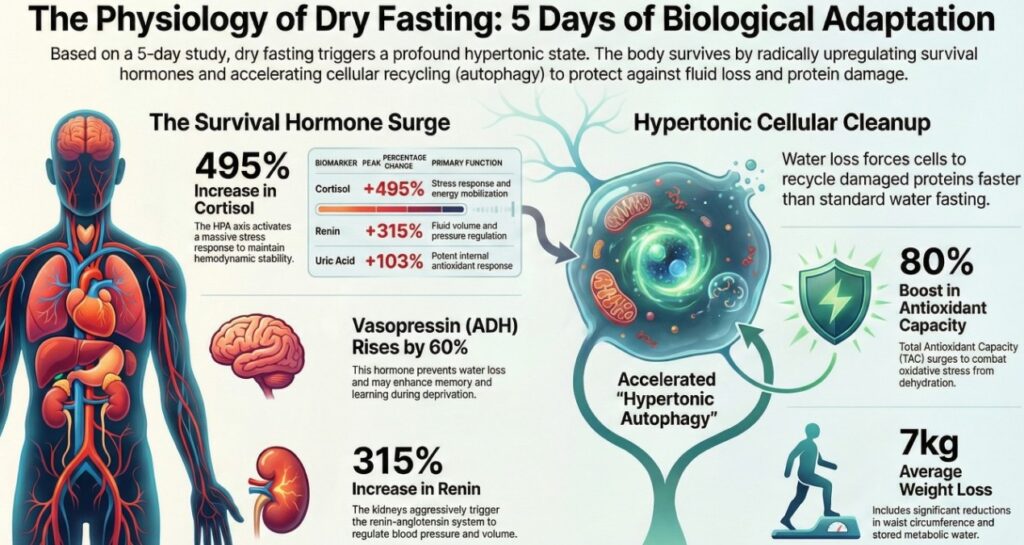
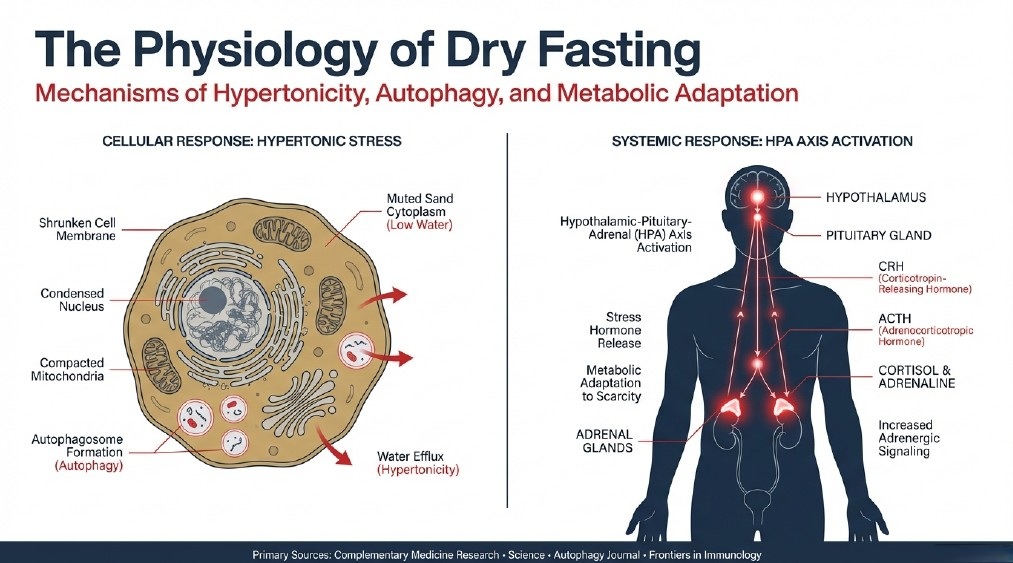
When you stop drinking water, something very interesting happens to your blood. It becomes slightly more concentrated because there is less fluid. This creates a state of “stress” for your cells, but it is a good kind of stress. Scientists call this hypertonicity. Because your cells are thirsty, they start looking for water in places they usually ignore.
The biggest source of hidden water in your body is actually your fat. Your fat cells are like little sponges filled with energy and hydrogen. When your body needs water and cannot find it in a glass, it starts burning fat to create “metabolic water.” This is the same way a camel survives in the desert for weeks without a drink. By dry fasting for just 12 to 16 hours, you are essentially forcing your body to become a fat-burning machine.
Hypertonic Autophagy: The Fast Lane to Clean Cells
We mentioned the word autophagy earlier. It comes from Greek words that mean “self-eating.” It sounds a bit scary, but it is actually the most important thing your body does to stay young and avoid insulin resistance. During autophagy, your cells find old, broken parts and “eat” them to make new, healthy parts.
Normally, you have to fast for two or three days with water to get a lot of autophagy. However, when you do a dry fast, the process speeds up tremendously. Research published in the journal Autophagy shows that when cells are under “hypertonic stress” from a lack of water, they start to build “autophagosomal clusters.” These are like giant trash bags that collect all the broken proteins in the cell.
This is why 12 to 16 hours of dry fasting can sometimes be as powerful as two full days of regular water fasting. It is a “clinical strike” against the junk that causes your cells to stop responding to insulin. When the junk is gone, your cells become sensitive again, and your blood sugar starts to stabilize naturally.
The Camel Secret: Creating Water from Your Own Fat
Let us talk more about that “metabolic water.” This is one of the coolest parts of human biology. When your body burns one gram of fat, it can actually create more than one gram of water. This happens because fat is very high in hydrogen. When you breathe in oxygen, your body combines it with the hydrogen from the fat to make H2O, which is the scientific name for water.
When you are dry fasting, your body prioritizes burning fat over almost everything else because it needs that water to keep your blood flowing and your brain working. This is why many people who practice dry fasting during Ramadan notice that they lose more body fat than they do with regular dieting.
By creating this internal water, you are not just surviving, you are thriving. You are flushing out toxins and cleaning your internal systems from the inside out. It is a level of metabolic wellness that most people never get to experience because they are always sipping on water or snacking on food.
Vasopressin: The Brain Hormone That Helps You Heal
When you go without water for a little while, your brain releases a hormone called vasopressin. Most doctors only talk about how vasopressin helps your kidneys save water, but it does so much more. Studies on PubMed have shown that vasopressin actually helps your memory and your ability to learn new things.
When your vasopressin levels go up during a dry fast, your brain enters a state of high focus. It is like your body is saying, “We need to find water, so let us make sure the brain is working at 100 percent.” This boost in brain power is a great side effect of working on your insulin resistance.
Not only are you fixing your metabolism, but you are also giving your brain a biological upgrade. You might find that you are more productive and can think more clearly during your fasting window. This is the power of working with your body’s natural hormones instead of trying to fight them with caffeine or sugar.
Olive Oil: The Trojan Horse for Doubling Your Results
Now, you might be thinking, “If I am fasting, how can I use olive oil?” This is a special trick for people who want to reverse insulin resistance without doing a long, difficult fast. We call olive oil a “Trojan horse” because we use it to sneak a special message into your cells.
High-quality extra virgin olive oil contains a molecule called oleuropein. When you take a small amount of olive oil, your body does not just see it as calories. It sees it as a signal to activate your longevity genes. Even though the olive oil has a few calories, the oleuropein is so powerful that it keeps the “clean button” (autophagy) turned on.
In fact, using olive oil can actually double the rate of autophagy in your immune cells. It helps your immune system become smarter and faster at finding things that do not belong in your body. This is a game changer for metabolic wellness because it allows you to get the benefits of a long fast while still giving your body some healthy fats to keep you feeling full.
Unlocking Your Longevity Genes with Oleuropein
When the oleuropein from olive oil enters your system, it flips a switch on two very important genes called SIRT1 and FOX3. Scientists often call these the “longevity genes.” They are the same genes that get turned on when people exercise a lot or live in very cold places.
SIRT1 helps protect your cells from getting old and tired. It also makes your cells more sensitive to insulin, which is exactly what we want. FOX3 tells your cells to start the autophagy process and clean up the trash. By using olive oil as a tool, you are essentially telling your body to stay young and healthy at a genetic level.
This is why we say that metabolic wellness is not just about what you eat, but about the “signals” you send to your genes. If you send the signal for growth all the time by eating sugar, your house gets messy. If you send the signal for repair using fasting and olive oil, your house stays clean and beautiful.
The Dates Dilemma: Why This Sugar is Actually Okay
If you have insulin resistance, you have probably been told to stay away from all sugar. So, why are we talking about dates? Dates are very sweet and they have a lot of sugar, but they are not the same as a candy bar.
When you eat a date, you are also eating a lot of fiber. This fiber acts like a “speed limit” for the sugar. Instead of all the sugar rushing into your blood at once and causing a huge insulin spike, the fiber makes it enter slowly. This gives your body time to use the sugar for energy instead of storing it as fat.
Also, dates contain special things called tannins. These are the same healthy things found in green tea. Tannins actually block some of the enzymes in your stomach that break down sugar, which means you might not even absorb all the sugar that is in the date. Real-world tests show that for many people, dates barely raise their blood sugar at all compared to other snacks.
Nature’s Low-Insulin Candy: The Ultimate Fruit Guide
Not all fruits are the same when it comes to your blood sugar. Some fruits are full of glucose, which causes a big insulin spike. Other fruits are higher in fructose. While you do not want to eat too much fructose, it is actually better for your insulin levels because it does not trigger the same immediate “alarm” in your body.
If you want to support your metabolic wellness, here are the best fruits to choose:
- Avocados: These have almost zero sugar and are full of healthy fats that make you feel full.
- Raspberries: These are the “king of berries” because they have so much fiber. One cup of raspberries has 8 grams of fiber, which helps stop insulin spikes.
- Apples: They contain pectin, a special fiber that helps your cells become more sensitive to insulin.
- Cherries: These are very low on the glycemic index, meaning they release their energy very slowly.
- Guava: This fruit is amazing because it can actually block the process of turning food into blood sugar in the first place.
By picking these fruits, you can enjoy a sweet treat without ruining all the hard work you did with your fasting. Just remember to stick to about a half cup to a full cup a day.
Metabolic Flexibility: Training Your Body for the Future
The ultimate goal of everything we have talked about is called metabolic flexibility. This is the ability of your body to use whatever fuel is available. If you eat a potato, your body should be able to burn the sugar. If you skip a meal, your body should be able to switch over and burn your body fat effortlessly.
People with insulin resistance are “metabolically stuck.” Their bodies have forgotten how to burn fat because their insulin levels are always too high. By using dry fasting and olive oil, you are teaching your body how to switch between fuels again. You are training your metabolic engine to be more efficient.
This is not a diet that you have to do forever. It is a “clinical strike” that you can use whenever you feel like your body needs a reset. By mastering these tools, you are taking control of your health and ensuring that your “biological house” stays clean and energy-efficient for the rest of your life.
Frequently Asked Questions
Is dry fasting safe for everyone to try? Dry fasting is very powerful and it should be done with care. If you have kidney problems or if you are pregnant, you should check with a doctor first. For most healthy people, a short 12 to 16 hour dry fast like the ones done during Ramadan is a safe way to trigger autophagy.
Does olive oil really not break a fast? Technically, anything with calories breaks a fast. However, we use olive oil because the “signal” it sends to your genes is more important than the small number of calories it has. It keeps the benefits of the fast going while protecting your muscles and brain.
How many dates can I eat if I have insulin resistance? Most people can handle one or two dates a day, especially if they are the “Tamer” variety which are lower in sugar. It is always a good idea to eat them with a little bit of protein or fat to keep your blood sugar even more stable.
Can I drink water during the olive oil part of the plan? Yes. Once you have finished your dry fasting window, you should drink plenty of water. The olive oil protocol works great with water and can help you feel less hungry while your cells are cleaning themselves.
How often should I do a “cellular deep clean”? Many people find that doing a one-day reset once a week or once a month is enough to keep their metabolic wellness on track. It is all about finding a rhythm that works for your life.
Scientific Sources and Verifiable References
- Dry Fasting Physiology: Papagiannopoulos-Vatopaidinos, I. E., et al. (2020). Responses to Hypovolemia and Hypertonicity. Complementary Medicine Research. This study explains how the body creates its own water.
- Hypertonic Stress and Autophagy: Nunes, P., et al. (2013). Hypertonic stress promotes autophagy and microtubule-dependent autophagosomal clusters. Autophagy Journal. This research shows how dehydration speeds up cellular cleaning.
- Protein Misfolding Mechanisms: Kwon, H. M. (2008). Protein misfolding in hypertonic stress. American Journal of Physiology. This editorial explains the science of how stress triggers repair.
- Ramadan and Immune Function: Adawi, M., et al. (2017). Ramadan Fasting Exerts Immunomodulatory Effects. Frontiers in Immunology. This review looks at how dry fasting helps the immune system.
- Vasopressin and Cognition: Legros, J. J., et al. Effects of vasopressin on human memory functions. PubMed. This study details how fasting hormones help the brain.
- Dates and Glycemic Index: Miller, C. J., et al. The glycemic index of various date varieties. Journal of Nutrition. This provides the data on why dates are safer than regular sugar.
Disclaimer: The information in this blog is for educational and informational purposes only and is not intended as medical advice. Reversing insulin resistance and practicing dry fasting are serious health interventions. You should always consult with a qualified health professional or doctor before making changes to your diet, especially if you are taking medication or have an existing health condition.
Check out our related article here