
If you are a man over 60 and worried about prostate health, you likely know the mental math of the midnight hallway walk. You calculate the distance to the bathroom, scan for the nearest stall in public, and manage the quiet anxiety of long drives. Many men dismiss waking up multiple times a night or a weak, hesitant stream as the inevitable price of aging.
It is helpful to view the pelvic floor as acting like a clenched fist. Benign Prostatic Hyperplasia (BPH) is not simply a biological clock winding down; it is a physiological process where the body responds to internal signals. Symptoms are about mechanics and signaling, not just anatomy. Two men can have the same size on a scan yet experience completely different lives based on muscle tension and inflammation. By shifting from a state of forcing to releasing, you can prioritize your prostate health.
The “Healthy” Saboteurs: Managing Growth Signals
Many men follow mainstream nutritional advice religiously, eating foods marketed as heart-smart, yet find their symptoms worsening. As men age, testosterone declines while estrogen activity becomes relatively stronger. This makes the tissue sensitive to anabolic signals—hormones that tell cells to grow and divide.
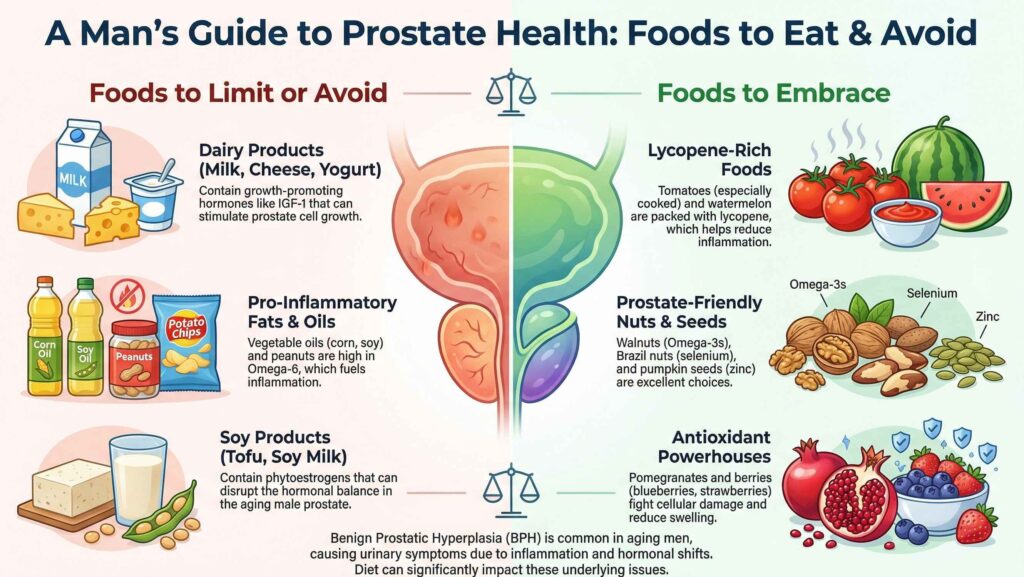
Soy contains isoflavones that can bind to estrogen receptors and trigger aromatase, the enzyme that converts testosterone into estrogen. Dairy products like milk and yogurt contain Insulin-like Growth Factor 1 (IGF-1), a hormone that stimulates cell division. Combined with the high insulin levels of a modern diet, this creates a double-edged sword that feeds tissue growth. Even vegetable oils high in Omega-6 are pro-inflammatory, which can narrow the urethral channel and intensify urgency.
The 30-Second “Long Exhale” Habit
Urinary discomfort is often exacerbated by the nervous system. When you are frustrated or tired, you unknowingly brace your abdomen and pelvic floor, which restricts flow. To break this cycle, you must teach your body to downshift before the stream begins. This simple habit is a cornerstone of maintaining better prostate health.
Start by softening your jaw and dropping your shoulders. Take a gentle four-second breath through your nose. Breathe out slowly through your mouth for eight seconds, as if you are softly fogging a mirror. Imagine the base of your pelvis melting downward like an elevator descending. Once the stream stops, wait ten seconds. Take one more long exhale and wait for a second release. This is vital because residual urine is a primary driver of urgency and repeat trips.
The Lycopene Powerhouse: Beyond Raw Tomatoes
Lycopene is a carotenoid that concentrates in tissue and inhibits the enzyme responsible for converting testosterone into DHT. Cooked tomatoes are a major asset for prostate health because heat increases bioavailability. A single tablespoon of tomato paste is often more effective than a raw tomato because the heat breaks down cell walls, allowing for maximum absorption.
Watermelon is another surprise superstar. It is more bioavailable than raw tomatoes and contains citrulline, an amino acid that improves pelvic blood flow. Focus on the deep red flesh closest to the rind where the concentration is highest. Always combine these with healthy fats like extra virgin olive oil to ensure delivery. Zinc-rich foods like seafood also help stop the conversion of testosterone into both DHT and estrogen.
The Smart Nut Swap
Snacking on the wrong nuts can fuel the very inflammation that pushes PSA levels higher. Peanuts are legumes that are often prone to molds which stress the immune system, while cashews are high in oxalates that can irritate the urinary tract and cause pelvic tightness. Supporting your prostate health requires choosing nutrient-dense alternatives.
Choose walnuts for their Omega-3s and zinc to support hormone balance, or Brazil nuts for selenium, which acts as an antioxidant shield. One or two Brazil nuts provide your daily requirement. Pistachios are also excellent as they support nitric oxide production for better pelvic circulation. Avoid macadamias in excess, as their high calorie density can lead to excess body fat, which further fuels BPH.
| Nuts to Limit | Nuts to Choose |
|---|---|
| Peanuts: High Omega-6 and potential aflatoxins. | Walnuts: High in Omega-3s and zinc to support hormone balance. |
| Cashews: High in oxalates and salt; can cause pelvic tightness. | Brazil Nuts: One or two nuts provide your daily Selenium, an “antioxidant shield.” |
| Macadamias: Extremely calorie-dense; excess body fat fuels BPH. | Pistachios: Support nitric oxide production for better pelvic circulation. |
Mechanics Over Masculinity: The Case for Sitting Down
There is a common myth that sitting to urinate is a sign of weakness. Clinically, thirty percent of the prostate is smooth muscle. When you stand, your pelvic floor and hip muscles must maintain tension to keep you upright. This tension can work against you when you are trying to empty your bladder.
Sitting down allows these muscles to fully relax, reducing the mechanical obstruction against the urethra. This leads to more complete bladder emptying and fewer false alarms throughout the night. Choosing better mechanics over outdated notions of masculinity is one of the fastest ways to improve your quality of life and support prostate health.
Conclusion: Healing is Cumulative
The body is a responding system, not a failing one. One of the most potent ways to inhibit growth signals naturally is to use the whole lemon. Try blending a whole lemon, including the peel, with water and a dash of stevia. The compounds in the peel are uniquely effective at regulating the hormonal signals that drive enlargement.
Healing happens when you change the environment of the gland. Try these dietary and mechanical shifts for the next 60 to 90 days. If your body is sending you signals at 2:00 A.M., it is time to listen to what it needs for long-term prostate health.
Frequently Asked Questions
Does sitting down to urinate really help with BPH? Yes. Clinical studies show that for men with an enlarged prostate, the sitting position allows for a more complete relaxation of the pelvic floor, leading to better flow and less residual urine.
Why are Brazil nuts specifically recommended? Brazil nuts are one of the densest natural sources of selenium. This mineral is essential for the production of glutathione, an antioxidant that helps protect cells from oxidative damage and supports a healthy immune response.
How does tomato paste compare to fresh tomatoes? Heating tomatoes during the production of paste breaks down the plant’s fibrous cell walls. This makes the lycopene up to four times more bioavailable than it is in raw fruit, making it much more effective for prostate health.
Sources
• The Journal of Urology: A study published here found that pomegranate extract significantly slowed the PSA doubling time in men previously treated for prostate cancer, suggesting a potent anti-growth effect.
◦ Search the Journal of Urology
• Cochrane Library: The sources refer to “Cochrane reviews,” which are high-quality systematic meta-analyses, to evaluate supplements like Saw Palmetto and Pygeum africanum,. These reviews currently show that Saw Palmetto may be no more effective than a placebo in large populations.
Related Articles
Apple Cidar Vinegar: Your Metabolic Ally
Disclaimer: The content in this playlist is for informational and educational purposes only. Fasting is a powerful biological tool. Always consult with your healthcare professional before beginning a new fasting protocol, especially if you have a pre-existing medical condition or are taking medication.